Modern customers expect fast, personalized, and seamless support across every channel. Contact center solutions are the technology backbone that makes this possible, turning every interaction into an opportunity to build loyalty and drive revenue. Organizations embracing the next era of business growth with AI call center solutions are discovering that AI in call centers is the key to future-proofing customer service, enabling smarter, faster, and more consistent customer interactions.
With the rise of cloud computing platforms for AI-driven customer service management, businesses can efficiently process large volumes of customer data and make informed decisions in real time. Integrating big data analytics with modern computer technology systems for customer engagement helps organizations predict customer needs, automate routine tasks, and improve overall operational efficiency.
Companies are also leveraging AI-based tools for personalized digital marketing campaigns and customer communication strategies, which enable precise targeting, better content delivery, and measurable marketing results. In the financial industry using AI to enhance customer experience, risk analysis, and automated support services, these technologies support faster, more reliable service and improve client satisfaction. By combining cloud-powered AI solutions with advanced business intelligence, digital marketing optimization, and secure financial technology platforms, organizations create a unified environment that drives growth, increases efficiency, and strengthens customer loyalty.
This guide walks through what contact center solutions are, how they work, the key features to look for, and how they help organizations deliver standout customer experiences while improving efficiency and controlling costs.
Top 10 Contact Center Solutions Providers
When choosing the right contact center solutions for your business, it’s important to evaluate providers that combine advanced technology, AI capabilities, and seamless customer engagement tools. Here are the top 10 companies leading the industry today:
1. Bright Pattern – AI-Powered Contact Center Solutions
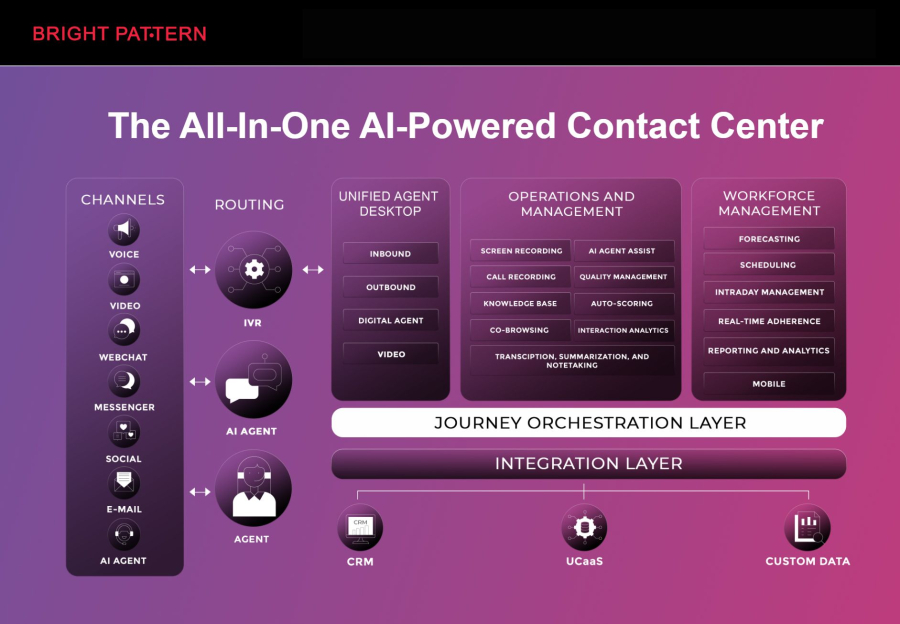
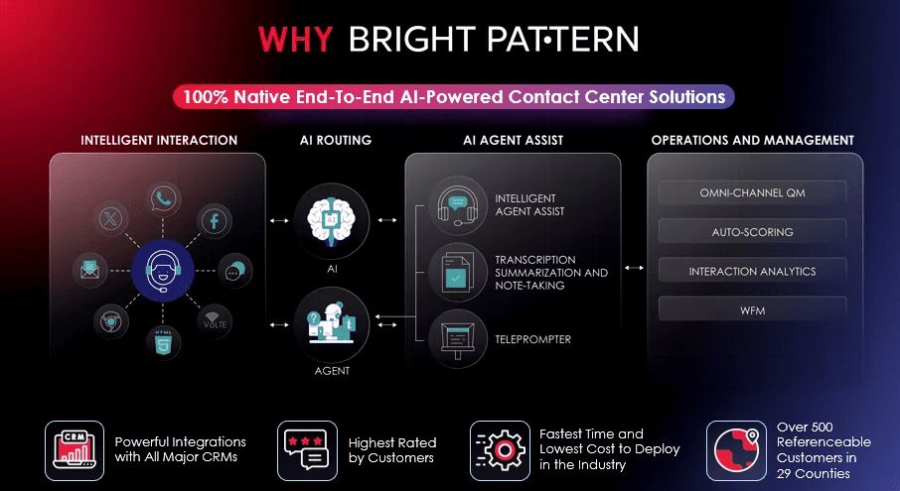
Bright Pattern is a leading provider of AI-driven contact center solutions designed to streamline customer interactions across multiple channels. Its cloud-based platform enables businesses to deliver personalized support, automate workflows, and improve operational efficiency. Key features include:
- AI-powered routing and analytics for faster resolution
- Omnichannel support across voice, chat, email, and social media
- Integration with CRM and marketing platforms for unified customer insights
- Scalable cloud architecture that grows with your business
- Automated self-service options to reduce agent workload
Bright Pattern is recognized for helping businesses improve customer satisfaction while driving revenue growth through intelligent contact center tools.
2. Genesys – Enterprise Contact Center Solutions
Genesys provides advanced contact center solutions that combine AI, automation, and workforce optimization. Its platform enables predictive engagement, omnichannel routing, and detailed performance analytics.
3. Five9 – Cloud Contact Center Software
Five9 offers cloud-based contact center solutions with AI integration for intelligent routing, speech recognition, and real-time reporting. It helps organizations deliver faster and more personalized customer service.
4. NICE inContact – Omnichannel Contact Center Platform
NICE inContact provides AI-powered customer experience management tools, including automated workflows, real-time insights, and support for multiple communication channels.
5. Talkdesk – Cloud Contact Center Solutions
Talkdesk delivers cloud contact center solutions designed for modern businesses, offering AI-driven automation, omnichannel engagement, and seamless CRM integration.
6. Avaya – Contact Center and Customer Experience Solutions
Avaya’s contact center platform focuses on delivering consistent, multichannel customer support with AI-enhanced routing, analytics, and workforce optimization tools.
7. Cisco Contact Center – AI and Cloud-Enabled Solutions
Cisco provides scalable contact center solutions with AI-enabled features for predictive analytics, intelligent routing, and seamless collaboration across teams.
8. RingCentral – Cloud Contact Center Solutions
RingCentral combines cloud communication with AI-powered contact center tools to streamline customer interactions, improve response times, and support omnichannel engagement.
9. 8x8 – AI-Enhanced Cloud Contact Center
8x8 offers cloud-based contact center solutions with AI-driven analytics, speech recognition, and unified communications to enhance customer experience and operational efficiency.
10. Amazon Connect – AI Contact Center on the Cloud
Amazon Connect delivers scalable, AI-powered cloud contact center solutions that allow businesses to automate interactions, optimize routing, and personalize customer service experiences.
What Are Contact Center Solutions?
Contact center solutionsare integrated platforms that manage all customer interactions across voice and digital channels. They route inquiries to the right agents, provide tools to resolve issues quickly, and capture data that helps leaders continually improve service quality.
Unlike traditional call centers that focused mainly on voice, modern contact center solutions support multiple channels in a unified way, including:
- Inbound and outbound voice calls
- Email support
- Web chat and in-app chat
- Social media messaging
- SMS and messaging apps
- Self-service and knowledge bases
- AI-powered chatbots and virtual agents
The result is a single, coordinated environment where customers can choose how they want to engage, and agents have everything they need to help them effectively.
Core Business Benefits of Modern Contact Center Solutions
Upgrading to a modern, cloud-based, omnichannel contact center delivers measurable benefits for customers, agents, and the business as a whole.
1. Better Customer Experience and Loyalty
- Faster responsesthanks to intelligent routing, self-service options, and prioritization of urgent issues.
- Consistent experiencesacross channels, so customers do not have to repeat information when they switch from chat to phone or email.
- Personalized servicepowered by customer history, preferences, and context shared in real time with agents.
- Always-on supportthrough automated chatbots and knowledge bases, available outside typical business hours.
These improvements translate directly into higher customer satisfaction scores, stronger loyalty, and more word-of-mouth advocacy.
2. Higher Agent Productivity and Engagement
Modern contact center solutions are designed to make agents more effective and their work more rewarding.
- Unified agent desktopsbring together customer data, interaction history, and tools in a single view.
- Automationhandles repetitive tasks like call logging, case creation, or simple FAQs so agents can focus on higher-value conversations.
- Real-time guidancevia prompts, scripts, and knowledge suggestions helps new agents get up to speed quickly.
- Flexible work optionssupport remote and hybrid teams with cloud-based access and secure connectivity.
When agents are equipped with the right tools and support, they handle more interactions efficiently, deliver better service, and are more likely to stay with the organization.
3. Lower Costs and Greater Operational Efficiency
Well-implemented contact center technology can significantly reduce the cost to serve each customer, without sacrificing quality.
- Cloud deploymenteliminates the need for heavy upfront hardware investments and reduces maintenance burden.
- Workforce optimizationtools predict staffing needs, helping avoid both understaffing and overstaffing.
- Self-servicedeflects routine inquiries from live agents, lowering overall volume.
- AI-driven routing and automationshorten average handle time and increase first-contact resolution.
Organizations typically see savings through reduced infrastructure costs, more accurate staffing, and higher agent productivity.
4. Rich Insights and Continuous Improvement
Every interaction is a source of valuable data. Modern solutions capture and analyze this data to support smarter decisions.
- Real-time dashboardshighlight queues, wait times, service levels, and agent performance at a glance.
- Analytics and reportinguncover recurring issues, peak times, and channel preferences.
- Speech and text analyticsidentify sentiment trends, compliance risks, and emerging customer needs.
These insights drive targeted improvements to processes, training, and customer journeys, creating a positive feedback loop for service quality.
Key Capabilities of Modern Contact Center Solutions
While different platforms offer different feature sets, most leading contact center solutions include a common set of core capabilities. Understanding these helps you evaluate options and align technology with business goals.
Omnichannel Routing and Queuing
Omnichannel routingensures that contacts from any channel are prioritized and directed based on business rules, agent skills, and customer context.
- Single queue for multiple channels with clear priority rules.
- Skill-based routing to connect customers with specialists who can resolve issues quickly.
- Queue callbacks that reduce hold times by allowing customers to request a return call.
Unified Agent Desktop
The agent desktop is where the daily work happens. A unified, well-designed desktop:
- Displays customer identity and history in a single pane.
- Shows current interaction details from any channel.
- Offers quick access to knowledge articles, macros, and templates.
- Integrates with CRM and ticketing systems to avoid double entry.
Interactive Voice Response (IVR) and Self-Service
IVRand self-service tools let customers solve simple issues without waiting for an agent, saving time for everyone.
- Menu-based IVR for payments, order status, and account information.
- Natural language IVR that understands spoken requests.
- Self-service portals and knowledge bases for how-to questions.
- Chatbots that handle routine inquiries and escalate complex ones.
Workforce Management and Quality Management
Workforce and quality tools help maintain high performance and a consistent customer experience.
- Workforce managementforecasts demand, builds schedules, and tracks adherence.
- Quality managementsupports call recording, screen capture, and evaluation forms.
- Coaching toolsallow supervisors to monitor interactions and provide targeted feedback.
Analytics, Reporting, and Dashboards
Built-in analytics allow leaders to track performance and make proactive adjustments.
- Standard reports for key metrics like average handle time and service level.
- Custom report builders for specific business questions.
- Real-time wallboards showing queues and agent availability.
AI, Automation, and Assistive Technologies
Artificial intelligence is increasingly central to contact center strategies. Modern solutions use AI to:
- Automate simple interactions with virtual agents and chatbots.
- Classify and route contacts based on intent and sentiment.
- Provide real-time suggestions, next-best actions, and knowledge recommendations to agents.
- Summarize conversations automatically for efficient wrap-up.
These capabilities accelerate service, improve consistency, and give agents supercharged support in the background.
Types of Contact Center Solutions
Contact center solutions can be deployed in several ways, each with distinct strengths.
|
Type |
Key Characteristics |
Ideal For |
|
On-premises |
Installed and managed in your own data center; higher control, higher maintenance. |
Organizations with strict data residency or customization requirements. |
|
Cloud (public or private) |
Hosted by a provider; scalable, subscription-based, frequent feature updates. |
Most modern contact centers seeking agility and lower upfront costs. |
|
Hybrid |
Mix of on-premises and cloud; gradual migration path, flexible architecture. |
Enterprises transitioning from legacy systems to the cloud. |
Cloud Contact Center Solutions
Cloud-based platforms have become the standard for new deployments because they offer:
- Rapid deploymentcompared to traditional hardware-based systems.
- Elastic scalabilityto handle seasonal peaks or unexpected surges.
- Predictable operating coststhrough subscription pricing.
- Automatic updateswith access to the latest features and security enhancements.
This flexibility is especially valuable for growing organizations and those operating across multiple locations.
Omnichannel Contact Center Solutions
Omnichannel solutions go further than multichannel by connecting every channel behind the scenes. Customers can start on one channel and continue on another without losing context.
Key benefits include:
- Channel freedomfor customers without sacrificing continuity.
- Unified reportingthat views performance across all channels.
- Consistent processesregardless of entry point, improving quality and compliance.
AI-Enhanced and Digital-First Contact Centers
Digital-first contact centers emphasize messaging, chat, and automation while still supporting voice. AI-enhanced platforms:
- Use chatbots and virtual agents as the first line for simple requests.
- Promote asynchronous channels like messaging where customers can respond at their convenience.
- Leverage machine learning to optimize routing and predict customer needs.
This model works particularly well for organizations with digitally savvy customers who value speed and convenience.
How to Choose the Right Contact Center Solution
Selecting the right platform is a strategic decision that affects customer satisfaction, employee engagement, and cost structure for years. A thoughtful evaluation process ensures a strong fit.
1. Clarify Business Objectives
Start with clear goals. For example:
- Reduce average wait times.
- Increase first-contact resolution.
- Support remote and global teams.
- Launch new digital channels such as chat or messaging.
- Improve reporting for compliance or service-level agreements.
Defining success upfront helps you prioritize capabilities and measure return on investment.
2. Map Customer Journeys and Channels
Understand where and how customers want to interact with you. Consider:
- Which channels are most heavily used today.
- Which channels you plan to add in the next 12 to 24 months.
- Key handoffs, such as moving from self-service to live support.
Choose a solution that supports current needs and makes it easy to expand to new channels without disruption.
3. Evaluate Integration Capabilities
Your contact center should not stand alone. It should connect with:
- Customer relationship management and ticketing platforms.
- Back-office systems for billing, orders, and account changes.
- Authentication and security tools, such as identity providers.
Strong integration capabilities lower manual work, reduce errors, and give agents a complete customer picture.
4. Consider Scalability and Flexibility
Look for platforms that can grow and adapt with your organization. Key questions include:
- How easily can you add or remove agents and channels?
- Can you support multiple locations and remote work without complexity?
- Does the solution support your data residency and compliance needs as you expand?
5. Prioritize Security, Compliance, and Reliability
Customer trust depends on safeguarding their data and ensuring reliable service. Evaluate:
- Data encryption and access controls.
- Support for relevant standards in your industry.
- Uptime commitments and redundancy designs.
- Monitoring and incident response processes.
6. Assess Ease of Use and Adoption
Technology only creates value if people use it effectively. When comparing options, consider:
- How intuitive the agent and supervisor interfaces are.
- Availability of training resources and admin tools.
- How quickly new hires can become productive with the system.
Best Practices for Implementing Contact Center Solutions
A thoughtful implementation multiplies the benefits of your new solution. The following practices help ensure a smooth rollout and rapid results.
Involve Stakeholders Early
Include representatives from customer service, IT, operations, compliance, and even marketing or sales. This helps:
- Capture a full picture of requirements.
- Anticipate potential issues before launch.
- Build support and enthusiasm across departments.
Start with Pilot Groups and Phased Rollouts
Launching in phases allows you to refine configurations and training before scaling. For example:
- Begin with one region, line of business, or channel.
- Gather feedback from agents and supervisors.
- Adjust scripts, routing rules, and dashboards.
- Expand to additional teams once the model is proven.
Invest in Training and Change Management
Successful contact centers invest heavily in onboarding and support. Effective programs:
- Provide role-based training for agents, supervisors, and administrators.
- Offer quick reference guides and knowledge articles.
- Use coaching tools and quality reviews to reinforce best practices.
Continuously Optimize After Go-Live
Implementation is not the finish line; it is the starting point for ongoing improvement. Plan to:
- Review metrics weekly and monthly to identify trends.
- Fine-tune routing, IVR menus, and self-service content.
- Regularly refresh training to align with new features and policies.
Key Metrics to Measure Contact Center Success
To understand the impact of your contact center solution, track a mix of efficiency, quality, and experience metrics.
Operational Efficiency Metrics
- Average handle timeincluding talk, chat, and after-contact work.
- Service levelsuch as percentage of contacts answered within a target time.
- Abandonment rateshowing how many customers leave the queue before being served.
- Agent utilizationto balance productivity and workload.
Quality and Experience Metrics
- First-contact resolutionindicating how often issues are solved on the first interaction.
- Customer satisfactionmeasured through surveys after interactions.
- Net promoter or loyalty metricsto track long-term relationship strength.
- Quality scoresfrom call and interaction evaluations.
Business Impact Metrics
- Cost per contactacross channels.
- Revenue influencedthrough cross-selling, upselling, or retention.
- Churn reductiontied to improved service.
Modern solutions make it easier to capture and interpret these metrics, helping leaders prove value and continually refine their strategies.
Real-World Outcomes: What Organizations Achieve
Organizations across industries have transformed their customer support and engagement with modern contact center solutions. Typical outcomes include:
- Significant reductions in average wait times and abandoned calls.
- Higher first-contact resolution rates through smarter routing and better tools for agents.
- Noticeable improvements in customer satisfaction and loyalty scores.
- Cost savings from shutting down legacy systems and consolidating platforms.
- Stronger employee engagement, especially among agents empowered with intuitive tools and flexible work options.
These improvements build on one another, turning the contact center from a cost center into a strategic asset that actively contributes to growth.
The Future of Contact Center Solutions
The pace of innovation in customer engagement is accelerating. Forward-looking contact centers are already embracing:
- Deeper AI integrationwith more accurate intent detection, predictive routing, and automated summarization.
- Proactive service modelsthat contact customers about issues before they arise.
- Expanded digital and asynchronous channelsthat fit naturally into customers' daily lives.
- Holistic experience strategiesthat align marketing, sales, and service around a single view of the customer.
By investing in flexible, AI-ready contact center solutions today, organizations position themselves to deliver the kind of experiences customers will expect tomorrow.
Conclusion: Turning Customer Contact into Competitive Advantage
Contact center solutions have evolved far beyond basic call handling. They are now powerful platforms for orchestrating every interaction, empowering agents, and capturing insights that fuel better decisions.
With the right combination of omnichannel capabilities, cloud agility, AI-driven automation, and strong analytics, your contact center can become a key driver of customer satisfaction, loyalty, and long-term growth.
Organizations that act now to modernize their contact center operations are not just solving today's service challenges; they are building a resilient foundation for exceptional customer experiences in the years ahead.
